Cognitive Actions

27 Cognitive Actions That Promote Self-Directed Learning

  1. Explain the significance
  2. Challenge something
  3. Draw a conclusion
  4. Form an important question
  5. Revise a question based on observation & data
  6. Critique something
  7. Observe something
  8. Revise something
  9. Transfer a lesson or philosophical stance from one situation to another
  10. Improve a design
  11. Identify a cause and effect
  12. Compare and contrast two or more things
  13. Test the validity of a model
  14. Separate causes from symptoms
  15. Identify the primary and secondary causes of a problem
  16. Adapt something for something new
  17. Make a prediction and observe what occurs
  18. Narrate a sequence
  19. Study and visually demonstrate nuance
  20. Identify and explain a pattern
  21. Study the relationship between text and subtext
  22. Elegantly emphasize nuance
  23. Critically evaluate a socially-accepted idea
  24. Extract a lesson from nature
  25. Take & defend a position
  26. Record notes during and after observation of something
  27. Form a theory & revise it based on observation and/or data
Similar Posts

  • A Brave New World AP Journal Prompts

    Short Response: 1-4 complete sentences Extended Response 1-4 complete paragraphs Essay: 5 or more paragraphs (also called a ‘paper’ and can be informative, research-based, persuasive, etc.) Chapter 1 Vocabulary: pallid, callow, abject, geniality, florid, zealous, salinity, viscosity, bouillon, prodigious, viviparous, vivacious, interminable, deft, optimum, predestination, sultry, caste, decant. Explain how Huxley uses imagery to establish…

  • Writing Competencies

     Structure 1. Form precise simple sentences 2. Form powerful complex sentences 3. Create sentences using available writing strategies 4. Vary sentence length for effect 5. Structure paragraphs effectively for clarity and effect (SRE, SEE, CEC) Organization 1. Use logical idea organization (Cause/Effect, Chronological) 2. Vary idea organization for effect 3. Use clear introduction, body, and…

  • Reading Competencies

    Reading Competencies Idea 1. Identify and analyze a theme or thesis and its development (e.g, the use of supporting details, rhetorical techniques, literary devices, writing style, tone, mood, modalities, etc.)  2. Recognize how a theme or thesis or media fits into larger contexts (cultural, literary, digital, etc.) 3. Recognize and explain the features, nuance, history,…

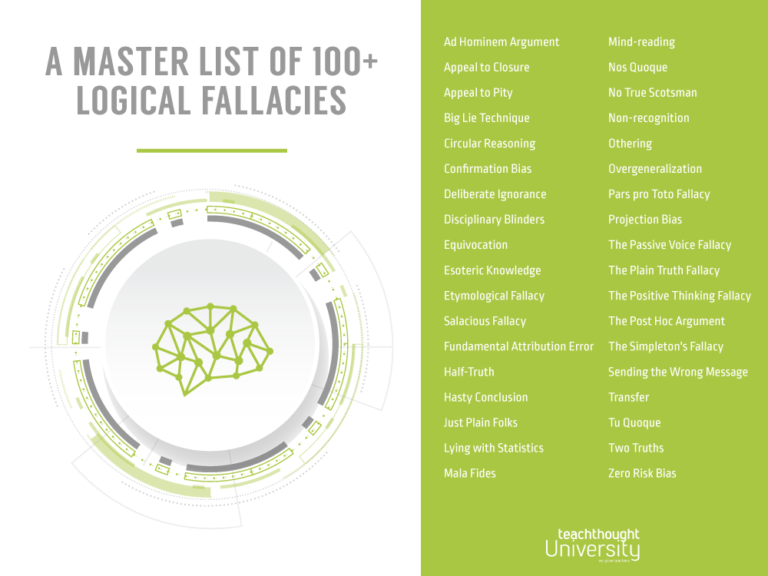
  • Logical Fallacies Master List

    A Complete Logical Fallacies List With Examples For Critical Thinking contributed by Owen M. Wilson, University of Texas El Paso A logical fallacy is an irrational argument made through faulty reasoning common enough to be named for the nature of its respective logical failure. The A Priori Argument Also: Rationalization; Dogmatism, Proof Texting A corrupt argument…